🏡 Limited time: Up to 8 Weeks FREE on select homesView Available Units

Open House every Thursday, 3PM – 5PM

Exclusive Offer: 6 Weeks FREE Rent On Select Units! Schedule a Tour Now →


1 Bed with Den Apartments in Seattle: Where to Find Them and What They Cost in 2026

1 Bed with Den Apartments in Seattle: Where to Find Them and What They Cost in 2026

TL;DR: A 1 bed with den apartment in Seattle is a one-bedroom unit that includes an additional enclosed or semi-enclosed room, usually without a closet, that can flex as a home office, guest room, or hobby space. These layouts run across Capitol Hill, South Lake Union, University Village, and Interbay, and they typically cost more than a standard one-bedroom because of the extra square footage. Contour Apartments in Interbay offers one-bedroom homes up to 809 square feet with the kind of flexible floor plans this search is looking for, plus rooftop and neighborhood access that a den alone cannot deliver.

Key takeaways

  • Identify the real difference between a true den, a flex room, and a home office nook before you tour, so you do not pay den pricing for a room with no door.
  • Compare neighborhoods like Capitol Hill, South Lake Union, University Village, and Interbay since den availability and pricing vary block by block.
  • Calculate the actual cost premium of a den against your monthly budget instead of assuming it always adds a fixed dollar amount to rent.
  • Prioritize natural light and window placement in the den, since many of these rooms have no exterior window and can feel closed off.
  • Schedule a tour at a community like Contour Apartments to walk the layout in person before signing, since floor plans on a website rarely convey how a den actually functions day to day.

What Counts as a 1 Bed with Den in Seattle

A den in Seattle apartment listings usually means an enclosed or partially enclosed room attached to a one-bedroom unit that lacks a closet or egress window, which is why it cannot legally be marketed as a second bedroom. The term gets used loosely across listing sites, so it pays to know the difference between a true den, a flex space, and a nook before you filter your search.

The Legal and Practical Definition

Most jurisdictions, including Seattle, require a room to have a closet and a window that meets egress code before it can be called a bedroom. A den skips one or both of those requirements. That is not a downside by default, it just means the room is classified differently and priced differently than a true second bedroom. This distinction matters because searches like “1 bedroom apartment with den” often turn up listings that are technically one-bedroom-plus-flex-space rather than a true two-bedroom alternative. Reading the floor plan carefully, not just the marketing copy, tells you what you are actually getting.

  • Closet check. A true den rarely has a reach-in or walk-in closet, while a legal second bedroom always does.
  • Window check. Many dens have no exterior window at all, or a small interior one that does not meet egress standards.
  • Door check. Some dens have a sliding door or French doors, others are open to the living room with no door at all.

Den vs Flex Room vs Home Office Nook

Listing sites use “den,” “flex room,” and “office nook” almost interchangeably, but the size and privacy level differ. A den is typically large enough to fit a queen bed and a dresser, even without a closet. A flex room is smaller, often just enough for a desk and a chair. An office nook is usually an alcove off the living room with no door at all. If you are searching specifically for “1 bed with den apartments Seattle,” you are likely looking for the first category: a room with enough square footage and privacy to function as an occasional guest room or a closed-door workspace, not just a corner with a built-in desk.

  • Den. Enclosed room, no closet, sized for a bed or full workstation.
  • Flex room. Smaller enclosed or semi-enclosed space, best for a desk setup.
  • Office nook. Open alcove, no door, integrated into the living area.

A den is only worth paying for if it has a door, a window, and a job to do in your daily routine.

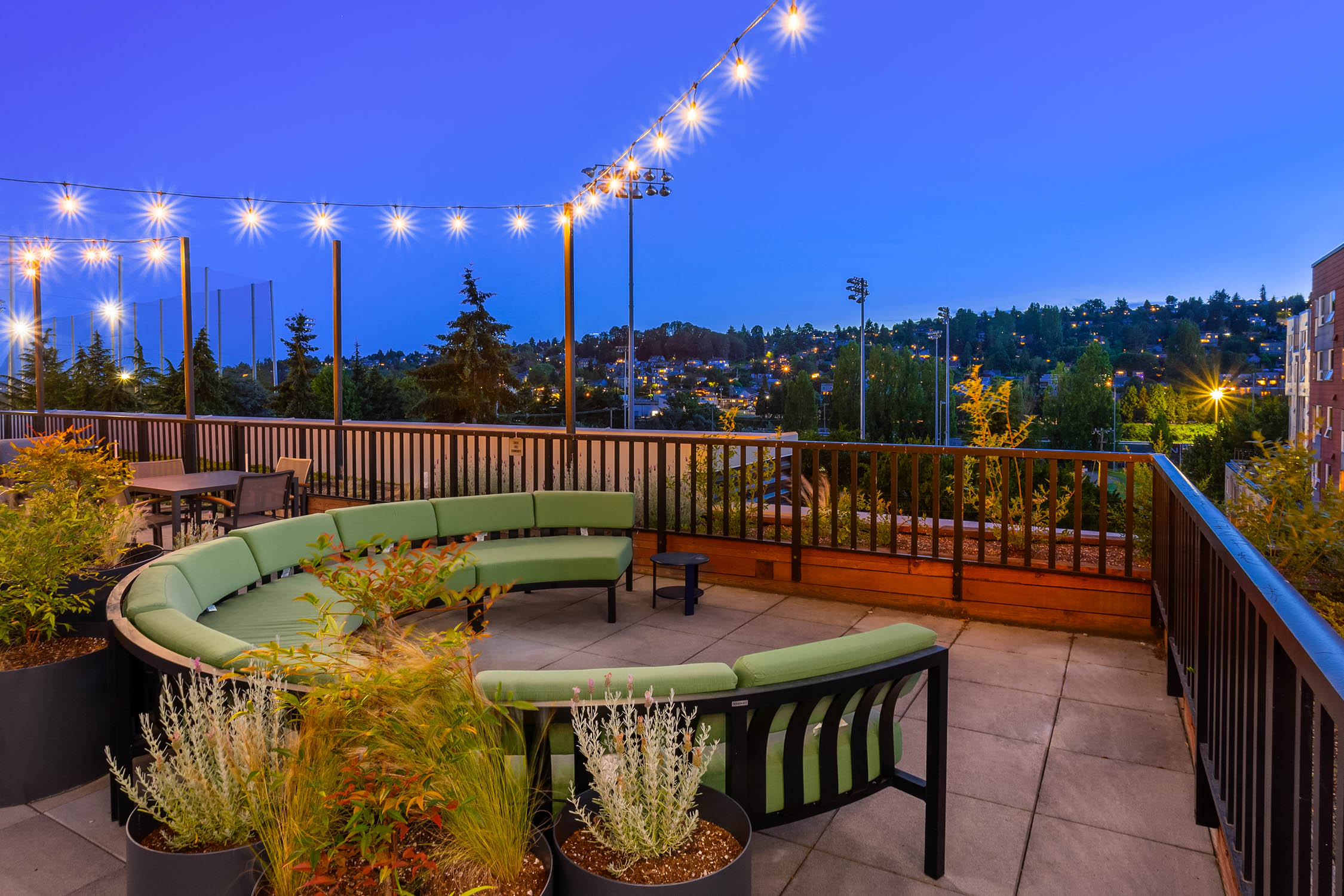
Rooftop terrace at dusk with curved bench seating and string lights at Contour Apartments

Where to Find 1 Bed with Den Apartments in Seattle

1 bed with den apartments show up most often in newer construction and mid-rise buildings across Capitol Hill, South Lake Union, University Village, and Interbay, where developers have leaned into flexible floor plans for renters who work from home part of the week. Availability shifts by building and season, so it helps to know which neighborhoods tend to carry this layout as a standard offering rather than an occasional unit.

Capitol Hill and Central Seattle

Capitol Hill has a concentration of newer buildings marketing one-bedroom-plus-den layouts, often in mid-rise developments near the light rail station. Buildings here tend to price the den as a meaningful step up from a standard one-bedroom, reflecting the neighborhood’s density and walkability to restaurants, nightlife, and transit. This is also the neighborhood where you will see the most direct competition among buildings for this exact layout, since several properties in the area actively market one-bedroom-plus-den units as a distinct product line rather than a rare floor plan.

South Lake Union and University Village

South Lake Union’s newer towers cater heavily to tech workers, and den layouts are common because they double as home office space close to major employers. University Village area buildings tend to offer larger footprints overall, so a den here often comes with more generous square footage than you would find in a denser urban core building. Both areas trend toward higher price points, largely because of proximity to major employment centers and the retail and dining density nearby.

Interbay and the Queen Anne, Magnolia Corridor

Interbay sits between Queen Anne and Magnolia and offers a different profile: newer, design-forward buildings with flexible one-bedroom layouts, but without the density or price pressure of Capitol Hill or South Lake Union. Contour Apartments, for example, offers one-bedroom homes up to 809 square feet, which is enough room for a genuinely usable flex layout rather than a cramped afterthought. This corridor also puts you close to Expedia’s headquarters, the D Line bus route, and outdoor access points like Discovery Park, which is a different value proposition than the den-heavy buildings closer to downtown.

1 Bedroom vs 1 Bed with Den vs 2 Bedroom in Seattle
Layout Typical Square Footage Best For Rent Positioning
Standard 1 Bedroom 550 to 750 sq ft Renters who want one dedicated bedroom and open living space Base pricing tier
1 Bed with Den 700 to 850 sq ft Renters who need a home office, guest space, or hobby room without a second full bedroom Mid tier, above standard 1BR
2 Bedroom 800 to 1,100 sq ft Renters who need two full bedrooms, each with a closet and door Highest tier

What a Den Actually Costs in Seattle

A den typically adds to your monthly rent compared to a standard one-bedroom in the same building, since it represents additional square footage even if it is not a legal bedroom. The exact premium varies widely by building, neighborhood, and how the property positions the unit, so the smartest approach is comparing den pricing against a second bedroom’s cost rather than assuming a fixed markup.

Den Pricing vs a True Second Bedroom

In most Seattle buildings, a one-bedroom-plus-den costs less than a comparable two-bedroom in the same property, but more than a standard one-bedroom. That gap exists because you are paying for extra square footage and functional flexibility, not for a second legal bedroom with its own closet and egress window. If your budget is close to two-bedroom territory anyway, it is worth comparing both options directly rather than assuming the den is automatically the cheaper path. Sometimes a smaller two-bedroom in a different building costs about the same as a one-bedroom-plus-den in a more amenity-heavy building.

Cheap 1 Bed with Den Options and What to Expect

Searches for “cheap 1 bed with den apartments Seattle” typically turn up older buildings, units on lower floors, or properties farther from the core employment corridors. These can be worth considering if the den itself has a real window and door, but it is common for budget-tier den listings to actually be flex nooks without a door, so the discount often reflects reduced privacy rather than a genuine deal. A more reliable way to find value is to look at newer buildings offering move-in incentives. Concessions like free weeks of rent can bring the effective monthly cost of a well-built den layout close to what you would pay for a bare-bones unit elsewhere, without sacrificing finish quality or amenities.

  • Compare effective rent. Factor in any free-rent weeks or waived fees, not just the sticker price.
  • Check the den’s window and door. A discounted den without either is a flex nook, not a real second room.
  • Ask about parking and pet fees. These add-ons can close the gap between a cheap unit and a nicer one fast.

Cost of Living Context for Interbay and Nearby Neighborhoods

Rent in Interbay, Queen Anne, and Magnolia generally sits below the most expensive pockets of South Lake Union and downtown, while still offering quick access to those job centers via the D Line and nearby arterials. That makes the area a practical middle ground for renters who want design-forward finishes and flexible layouts without paying premium-core pricing. Beyond rent, factor in proximity to daily needs. Interbay’s location near the Interbay Golf Center and Athletic Complex, Ballard, and Fremont means fewer long commutes for groceries, recreation, and dining, which can offset a modestly higher rent with lower transportation costs.

Landscaped lawn terrace with loungers and string lights at Contour Apartments

How to Evaluate a Den Layout Before You Sign

The best way to evaluate a den is to walk the unit in person and test whether the room can actually support how you plan to use it, since floor plans and marketing photos rarely show scale accurately. A quick checklist during your tour can save you from signing a lease for a room that looks larger on paper than it feels in real life.

Questions to Ask on a Tour

Before you commit, ask the leasing team specific questions about the den’s dimensions, door type, and window situation. Photos on a listing site can make a small nook look spacious, and wide-angle lenses are notorious for exaggerating room size. It also helps to ask how other residents in the building have used similar den layouts. Leasing staff often have direct experience seeing these rooms set up as offices, nurseries, guest rooms, or hobby spaces, and can tell you what has worked and what has felt cramped.

  • Ask for exact square footage of the den alone, not just the total unit.
  • Ask whether the door is solid, sliding, or glass, since this affects sound and light.
  • Ask if the den has any exterior window or if it borrows light from an adjacent room.
  • Ask about furniture placement limits, since low ceilings or odd angles can restrict layout options.

Testing the Space for Your Actual Use Case

If you plan to use the den as a home office, bring a tape measure and check that a desk, chair, and any equipment you need will fit with room to move. If you are considering it as an occasional guest space, think about whether a fold-out or Murphy bed setup is realistic given the door width and any closet limitations. For renters relocating to Seattle for work near Expedia’s headquarters or other Interbay-adjacent employers, a den that functions well as a home office can be more valuable day to day than a slightly larger living room, since remote and hybrid work schedules make a closed door for calls a practical necessity rather than a luxury.

Contour Apartments and the Interbay Alternative

Contour Apartments in Interbay offers one-bedroom homes up to 809 square feet, giving renters a layout with enough flexibility to carve out a genuine workspace or guest corner even without a formally labeled den. The building’s approach leans on generous square footage and smart-home features rather than marketing a separate den as a line item, which is worth understanding if you are comparing it against den-specific listings elsewhere in the city.

What Contour Offers Instead of a Marketed Den

Contour’s 117-home community sits at 3036 16th Ave W in Interbay, between Queen Anne and Magnolia, close to Ballard and Fremont. Its one-bedroom homes are sized to accommodate a flexible layout, with oversized floor-to-ceiling windows that bring in natural light, quartz countertops, full-size in-unit laundry, and smart home technology including Wi-Fi connected thermostats, Alexa-enabled controls, and keyless entry. While Contour’s floor plans include studios and one to two bedroom homes rather than a formally labeled one-bedroom-plus-den product, the larger one-bedroom units offer the kind of open, light-filled square footage that many renters are actually seeking when they search for a den, namely a place to set up a desk or reading nook without feeling boxed in.

Amenities That Extend Beyond the Unit

A den inside your apartment is one way to get workspace flexibility, but Contour also addresses that need at the building level. The community includes a co-working lounge for residents who want a change of scenery from a home office, along with a 24-hour fitness center with no gym membership required, a rooftop deck with views of the Olympic Mountains and Puget Sound, and a fire pit for barbecues. For renters weighing a den against a building’s overall amenities, it is worth checking a property’s amenities page directly, since a strong co-working lounge or rooftop space can reduce how much you actually need a private den at home.

  • Rooftop deck. Views of the Olympic Mountains and Puget Sound, useful for downtime beyond the unit itself.
  • Co-working lounge. An alternative to a home office den for focused work outside the apartment.
  • 24-hour fitness center. No membership required, reducing the need for at-home workout space.
  • Pet-friendly community. Applies throughout the property for renters relocating with animals.

Location and Access Points Around Interbay

Contour sits 0.7 miles from Expedia’s headquarters and 1.4 miles from Discovery Park, with the D Line bus stop at the door, which connects to downtown and other parts of the city without a car. Nearby points of interest include the Interbay Golf Center and Athletic Complex, Golden Gardens, the Ballard Locks, and Lake Union. This location profile positions Contour as a basecamp for both work and outdoor time, which is a different value calculation than a den-specific building deep in a denser urban core. Renters can review the property’s neighborhood page for a fuller picture of what is walkable versus a short bus or bike ride away, and the virtual tours give a sense of unit layouts before scheduling an in-person visit.

Co-working lounge booth seating with green upholstery at Contour Apartments

Making the Den Work for Your Life

A den earns its rent premium when it replaces a cost you would otherwise pay for elsewhere, such as a coworking membership, a storage unit, or a hotel stay for visiting guests. Thinking through your actual weekly routine, rather than an idealized use case, is the clearest way to decide if a den layout or a flexible larger one-bedroom is the better fit.

Common Den Use Cases in Seattle

Renters in Seattle tend to use den space for one of a few consistent purposes: a closed-door home office for hybrid work schedules, a guest room for visiting family or friends, a nursery, or a dedicated hobby space for things like music practice, crafting, or a home gym setup. Before committing to a den layout, rank your own priorities. If video calls are a daily reality, a door and some sound separation matter more than square footage. If the room’s main job is storage or occasional guests, a smaller flex space might do the job just as well as a larger, pricier den.

When a Larger One-Bedroom Beats a Den

If your den use case is loosely defined, a larger open one-bedroom, like the up to 809 square foot layouts at Contour, can often serve the same practical purpose without the added cost of a separately marketed den. An open floor plan with generous windows gives you room to section off a desk or reading corner using furniture, without paying a premium tied to a walled-off room you might only use occasionally. The right call depends on how much you value a literal door versus how much you value overall square footage, natural light, and building amenities. Touring both types of layouts side by side, ideally in the same week, makes the comparison much clearer than reading floor plans online.

Frequently Asked Questions

What is the difference between a den and a second bedroom in Seattle apartments?

A second bedroom must legally have a closet and a window that meets egress code, while a den typically lacks one or both of those features. This is why a one-bedroom-plus-den is priced below a true two-bedroom in most Seattle buildings.

Are 1 bed with den apartments cheaper than 2 bedroom apartments in Seattle?

Yes, in most buildings a one-bedroom-plus-den costs less per month than a comparable two-bedroom in the same property, since the den is extra flexible square footage rather than a full second bedroom with its own closet and window.

Which Seattle neighborhoods have the most 1 bed with den apartments?

Capitol Hill, South Lake Union, and University Village have a concentration of newer buildings marketing one-bedroom-plus-den layouts, while Interbay and the Queen Anne, Magnolia corridor offer larger flexible one-bedroom floor plans as an alternative.

Does Contour Apartments in Interbay offer a den layout?

Contour’s floor plans include studios and one to two bedroom homes, with one-bedroom units up to 809 square feet that offer flexible, light-filled space for a home office or reading nook, even though the property does not market a separately labeled den unit.

How much does a den typically add to monthly rent in Seattle?

The premium varies by building and neighborhood, but a den generally adds a moderate amount over a standard one-bedroom in the same property, reflecting the additional square footage rather than a fixed citywide rate.

Can a den in a Seattle apartment be used as a legal bedroom?

No, a den cannot be marketed or used as a legal bedroom unless it has a closet and a window meeting egress code, which most dens do not have by design.

What should I check before renting a 1 bed with den apartment?

Check the den’s exact square footage, whether it has a door and what type, and whether it has any exterior window, since these details affect both privacy and how comfortably the space functions for its intended use.

Is it worth touring a den apartment in person before signing a lease?

Yes, touring in person is the most reliable way to judge whether a den’s real dimensions and light levels match what photos and floor plans suggest, since wide-angle photography can make small rooms look larger than they are.

Are there cheap 1 bed with den apartments in Seattle?

Cheaper den listings exist mainly in older buildings or units on lower floors, but many budget-tier dens turn out to be open flex nooks without a door, so it is worth confirming the room’s actual layout before assuming it is a deal.

Finding the Right Fit in Seattle

A 1 bed with den apartment in Seattle can be a smart choice if you need a closed-door workspace, guest room, or hobby space and the unit you are considering has a genuine window and door, not just a marketed nook. Neighborhoods like Capitol Hill, South Lake Union, and University Village carry the most den-specific inventory, while Interbay offers an alternative in the form of larger, flexible one-bedroom layouts with strong access to both downtown employers and outdoor spaces like Discovery Park. If you are weighing a den against a larger open one-bedroom, Contour Apartments in Interbay is worth a look, with homes up to 809 square feet, smart-home features, a rooftop deck, and a co-working lounge that can cover the same needs a den is meant to solve. Browse the available apartments, check out the photo gallery and virtual tours, or schedule a tour to see the layouts firsthand. Contour also holds an Open House every Thursday from 3PM to 5PM, or you can apply now by calling (206) 650-7565.

Schedule a visit

Come see it in person.

Contour would love to show you around. Schedule a tour or check current availability, and find the home that actually fits.

Schedule a tour


Leave a Comment

Your email address will not be published. Required fields are marked *

Scroll to Top
Contour Apartments at Interbay seal with the building coordinates

Contact Contour at Interbay

Please complete the information below, and we will contact you right away!