🏡 Limited time: Up to 8 Weeks FREE on select homesView Available Units

Open House every Thursday, 3PM – 5PM

Exclusive Offer: 6 Weeks FREE Rent On Select Units! Schedule a Tour Now →


Apartments in Seattle to Rent: A Practical Guide to Neighborhoods, Pricing, and What to Look For

Apartments in Seattle to Rent: A Practical Guide to Neighborhoods, Pricing, and What to Look For

TL;DR: Renting an apartment in Seattle means weighing neighborhood, unit size, and building amenities against a wide price range that shifts by area, from denser downtown high-rises to lower-key pockets like Interbay between Queen Anne and Magnolia. The best approach is to narrow by commute and lifestyle first, then compare finish level, amenities, and any move-in concessions before signing a lease.

Key takeaways

  • Compare neighborhoods by commute and lifestyle before filtering by price, since Seattle rent varies significantly block to block.
  • Budget for total move-in cost, not just monthly rent, including deposits, pet fees, and parking where it applies.
  • Evaluate in-unit features like full-size laundry, quartz countertops, and smart home technology as real differentiators between comparable listings.
  • Use official and verified sources for affordable housing options rather than relying on unverified secondhand listings.
  • Schedule an in-person or virtual apartment tours visit before signing anything, since photos rarely capture layout, light, and noise accurately.

What Drives Seattle Apartment Prices

Seattle apartment rent depends primarily on neighborhood, unit size, building age, and proximity to major employers or transit lines. A studio in a newer building near a tech campus will cost more than a similar-sized unit in an older building further from downtown, and one-bedroom and two-bedroom units scale up from there based on square footage and finish level.

Average Rent Ranges by Unit Type

Rent in Seattle varies widely enough that a single citywide average is only a starting point. Studios generally sit at the lower end of the pricing spectrum, one-bedrooms occupy the middle range, and two-bedroom units command the highest monthly rent, though the exact figures shift with location and building vintage. Renters searching for apartments for rent Seattle under $1,000 will typically need to look at older buildings, shared housing arrangements, or income-restricted units rather than newer market-rate construction. Rather than anchoring to a single number, it helps to compare listings across multiple sources such as Zillow, Apartments.com, Redfin, and Realtor.com, since each aggregates slightly different inventory and updates on different schedules. Cross-checking a handful of current listings in your target neighborhood gives a more accurate read than any single average figure.

  • Studios. Typically the most accessible price point, especially in newer buildings with efficient layouts.
  • One-bedrooms. The most commonly searched unit type, with pricing that varies by square footage and building amenities.
  • Two-bedrooms. Priced highest overall, often shared by roommates to offset the per-person cost.
  • Concessions. Move-in specials like weeks of free rent can meaningfully lower effective monthly cost even when sticker rent looks high.

How Location Within the City Changes Cost

Distance from downtown and proximity to major employers like Expedia’s headquarters or the South Lake Union tech corridor tends to push rent upward, but that is not a fixed rule. Some neighborhoods a short distance from downtown, including pockets of Interbay and parts of Magnolia, offer newer buildings at rates more moderate than comparable units in Capitol Hill or Belltown because they are slightly further from the densest retail and nightlife corridors. Transit access also factors in. Being directly on a rapid bus line such as the D Line can reduce the practical cost of not living downtown, since it cuts commute time without requiring a downtown price premium.

The right Seattle apartment search starts with commute and lifestyle, not just a price filter.

Choosing a Seattle Neighborhood to Rent In

The right Seattle neighborhood depends on your daily commute, how much outdoor access matters to you, and whether you want density and nightlife at your doorstep or a quieter home base a short ride from it. Seattle’s neighborhoods differ enough in character that the same budget can buy very different lifestyles depending on where you land.

Downtown, Belltown, and South Lake Union

These areas put you closest to the urban core, major employers, and the widest range of dining and entertainment. Rent here tends to run higher, and units are often more compact, trading square footage for walkability and building amenities like rooftop lounges or on-site fitness centers. Renters prioritizing a car-free lifestyle or a short walk to work at a downtown or South Lake Union employer often find this trade-off worthwhile despite the higher price point.

Capitol Hill, Fremont, and Ballard

These neighborhoods offer a strong mix of independent restaurants, music venues, and walkable retail, with a rental stock that spans older character buildings and newer construction. Ballard in particular sits close to the Ballard Locks and has become a popular alternative for renters who want neighborhood character without being directly downtown. Commute times to downtown or South Lake Union from these areas are moderate, generally manageable by bus or bike, though not as immediate as living directly in the core.

Interbay, Queen Anne, and Magnolia

Interbay sits geographically between Queen Anne and Magnolia, within a short distance of Ballard and Fremont, and offers a different kind of trade-off: newer apartment stock, direct access to outdoor spaces like Discovery Park, and a quieter residential feel, while still keeping you close to major employers and transit. Queen Anne offers hilltop views and an established residential character, while Magnolia leans quieter still, with access to Discovery Park’s trails and beaches. For renters who want to describe their ideal home base as where the city meets the outdoors, this cluster of neighborhoods is worth serious consideration, particularly for anyone commuting to Expedia’s headquarters or elsewhere in the Interbay-Magnolia corridor.

  • Discovery Park. Roughly 1.4 miles from parts of Interbay, offering miles of hiking trails, beach access, and views of Puget Sound.
  • D Line. A rapid bus line connecting Interbay to downtown and Ballard, reducing the need for a car.
  • Golden Gardens. A nearby beach park popular for sunset views and shoreline walks.
  • Interbay Golf Center and Athletic Complex. A local recreation option within the immediate area.
The Interbay neighborhood surrounding Contour Apartments in Seattle
Seattle Rental Options by Neighborhood Type
Area Type Typical Unit Sizes What Drives the Price Good Fit For
Downtown / Belltown high-rise Studios to 2-bedroom, compact layouts Walkability, views, building amenities Short commute to core business districts
Capitol Hill / Fremont Studios to 2-bedroom, mix of new and older buildings Nightlife access, transit, dining density Renters prioritizing neighborhood energy
Interbay (between Queen Anne and Magnolia) Studios (480+ sq ft) to 2-bedroom (up to 809 sq ft for 1BR) Newer construction, outdoor access, tech-employer proximity Renters wanting outdoor access without a full commute to the core
South Lake Union Studios to 2-bedroom, newer high-rise stock Proximity to major employers, new construction premium Short commute to tech campuses

What to Look For in a Seattle Apartment

A strong Seattle apartment combines livable square footage, real in-unit conveniences like full-size laundry, and building amenities that reduce day-to-day friction, such as secure package receiving or a fitness center that does not require an outside gym membership. Comparing listings side by side on these specifics, rather than price alone, usually reveals meaningful differences between otherwise similar-looking units.

In-Unit Features That Matter

Floor-to-ceiling windows, quartz countertops, and full-size in-unit laundry are no longer rare in newer Seattle buildings, but they are far from universal, especially in older housing stock. Smart home technology, including Wi-Fi connected thermostats, Alexa-enabled controls, and keyless entry, has also become a meaningful differentiator, particularly for renters who value convenience and energy efficiency. When comparing apartment amenities in Seattle across multiple listings, it helps to make a checklist and score each unit against it rather than relying on memory after touring several properties in one day.

  • Laundry. Full-size in-unit washer and dryer versus shared building laundry versus none at all.
  • Natural light. Floor-to-ceiling windows change how a small unit feels day to day.
  • Smart home features. Keyless entry and connected thermostats add convenience and can lower utility costs.
  • Finish level. Quartz countertops and contemporary interiors signal newer construction or a recent renovation.

Building Amenities Worth Comparing

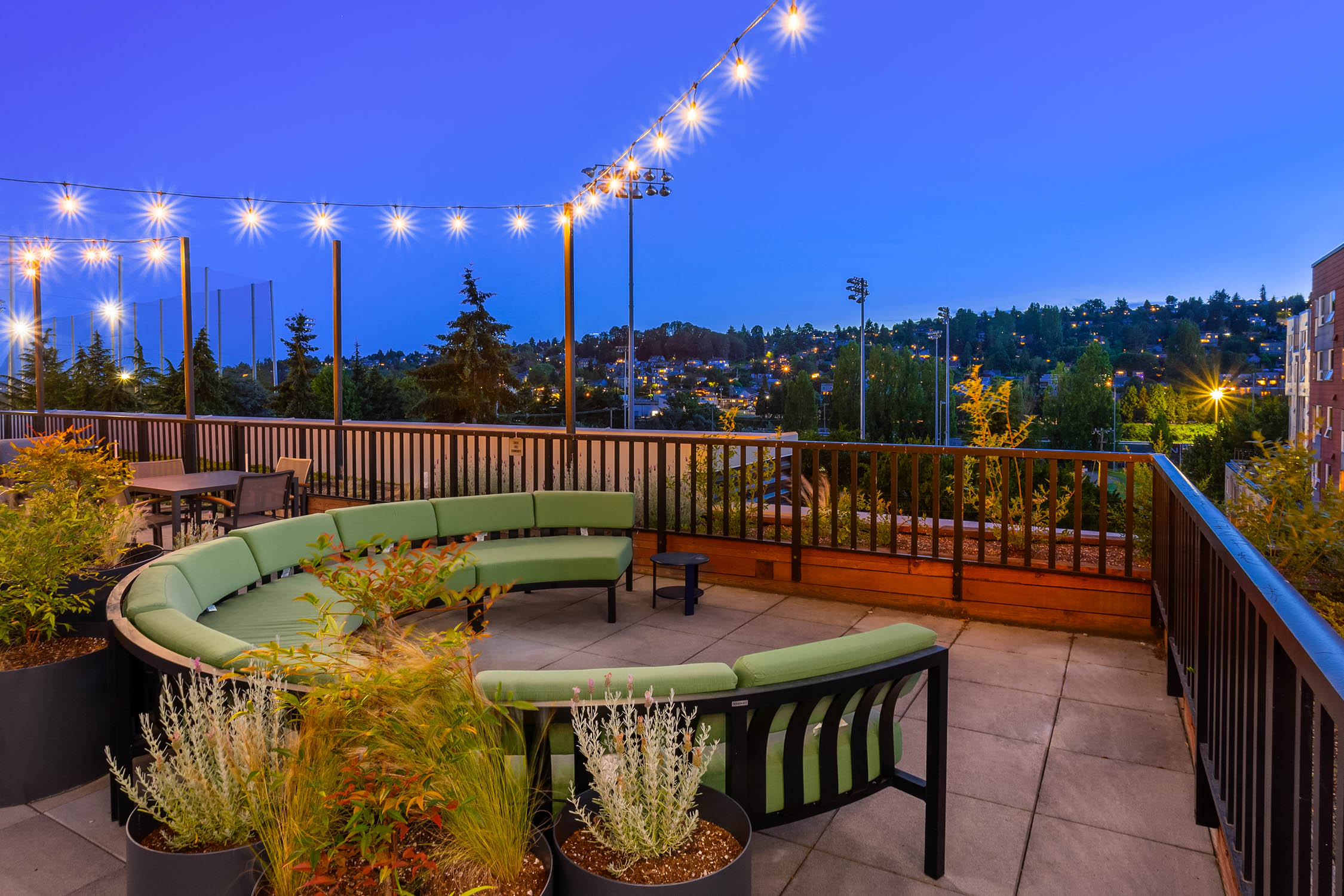
Beyond the unit itself, building-wide amenities can meaningfully affect quality of life and effective cost of living. A 24-hour fitness center that requires no outside gym membership, for example, can offset a separate monthly gym cost entirely. A rooftop deck with views of the Olympic Mountains and Puget Sound, a fire pit for gathering, and a co-working lounge all extend your living space beyond the four walls of your unit. Practical amenities matter just as much: controlled access parking, secure package receiving, bike storage, and concierge service all reduce daily friction, particularly in a city where package theft and parking scarcity are common frustrations.

  • Fitness access. On-site gyms with no added membership fee save money over time.
  • Outdoor space. Rooftop decks and fire pits add usable square footage without added rent per square foot.
  • Package and parking security. Controlled access and dedicated package receiving reduce common urban rental headaches.
  • Pet policies. Pet-friendly buildings throughout, rather than restricted to certain floors, matter for renters with animals.

Sustainability and Building Certifications

An increasing number of Seattle renters are factoring building sustainability into their decision, both for environmental reasons and because efficient buildings often mean lower utility bills. Certifications like Built Green 4 Star indicate a building was constructed with water and energy efficiency in mind, which can translate into real monthly savings alongside the environmental benefit. Landscaping choices matter too. Buildings that have invested in substantial tree planting and green space tend to offer a more comfortable microclimate and a more pleasant walk to and from the building.

Aerial view of Contour Apartments and its rooftop deck in Interbay, Seattle

Finding Affordable and Low-Cost Options

Affordable rental housing in Seattle generally falls into three categories: income-restricted units, older market-rate buildings with lower rent, and shared housing arrangements, and each requires a different search strategy. Renters searching for low income apartments in Seattle to rent should start with verified public resources rather than general listing sites, since income-restricted units are not always well represented on commercial platforms.

Where to Start for Income-Restricted Housing

The City of Seattle maintains resources for finding affordable rental housing, including listings of income-restricted units tied to specific eligibility thresholds. These are the most reliable starting point for renters who need housing priced well below market rate, since they are verified and updated by a public agency rather than aggregated from third-party postings. Waitlists for these units can be long, so it is worth applying broadly and early rather than waiting for a single preferred building to open availability.

What to Watch for With Cheap Listings

Renters searching seattle apartments for rent cheap or browsing seattle apartments housing for rent on classifieds sites should apply extra scrutiny to listings that seem significantly below market rate for their unit type and location. Common issues include outdated listings still showing after the unit has been rented, photos that do not match the actual unit condition, and in rare cases outright rental scams that ask for payment before a lease is signed or a unit is viewed in person. A reasonable rule of thumb: never wire money or pay a deposit for a unit you have not seen in person or via a verified virtual apartment tours option, and be cautious of landlords who refuse any form of video call or in-person walkthrough.

  • Verify the source. Confirm listings on multiple platforms before assuming a price is accurate.
  • Ask for a tour. Refusal to show a unit in person or virtually is a red flag.
  • Check the address. Search the property address separately to confirm it is a real, currently available listing.
  • Read the lease. Confirm any advertised price includes or excludes utilities, parking, and fees.

Realistic Expectations on Very Low Budgets

Nationally, questions like where can I live for $500 a month in the USA typically point toward smaller cities, shared housing, or income-restricted programs rather than market-rate studios in major metros like Seattle. Within Seattle specifically, a $500 monthly budget for an entire unit is not realistic in the current market outside of subsidized housing or room-in-a-shared-house arrangements. A more productive approach for budget-conscious renters is to widen the search to include roommates, look slightly further from the urban core, or specifically target buildings currently offering move-in concessions, which can meaningfully lower effective monthly cost during a lease’s early months.

Interbay neighborhood near Contour Apartments in Seattle

Why Interbay Is Worth a Look

Interbay sits between Queen Anne and Magnolia and offers newer apartment construction, direct transit access, and proximity to outdoor recreation that is harder to find in denser downtown neighborhoods. For renters comparing apartments for rent in Interbay Seattle against downtown or Capitol Hill options, the trade-off is generally a quieter setting in exchange for a short transit ride into the busier parts of the city.

A Basecamp for Work and Outdoor Access

Contour Apartments, located at 3036 16th Ave W in Interbay, illustrates what this neighborhood offers well: a 117-home community roughly 0.7 miles from Expedia’s headquarters and 1.4 miles from Discovery Park, with the D Line bus stopping directly at the property. That combination puts a major employer, a rapid transit line, and one of the city’s largest natural areas within easy reach of a single address. The community offers studios starting at 480 square feet and one-bedrooms up to 809 square feet, along with two-bedroom layouts, giving renters at different life stages and budgets a range of options within the same building. For anyone weighing an Interbay Seattle neighborhood guide against other parts of the city, the core appeal is this balance of commute, nature access, and newer construction.

What Contour Apartments Offers Specifically

Homes at Contour feature contemporary interiors, oversized floor-to-ceiling windows, quartz countertops, and full-size in-unit laundry, paired with smart home technology including Wi-Fi connected thermostats, Alexa-enabled controls, and keyless entry. Community amenities include a rooftop deck with views of the Olympic Mountains and Puget Sound, a 24-hour fitness center with no outside gym membership required, a co-working lounge, a fire pit for gatherings, bike storage, package receiving, controlled access parking, and concierge service. The property is pet-friendly throughout and Built Green 4 Star certified, with more than 1,800 trees planted on and around the site as part of its water and energy efficiency approach. Current leasing offers include up to 8 weeks free rent on select units and up to 6 weeks free on vacant homes, terms apply, and prospective renters can attend the weekly Open House held every Thursday from 3PM to 5PM.

  • Studios. Starting at 480 square feet, suited to renters prioritizing an efficient, low-maintenance footprint.
  • One-bedrooms. Up to 809 square feet, offering more separated living and sleeping space.
  • Rooftop deck. Direct views of the Olympic Mountains and Puget Sound from the building itself.
  • Move-in offers. Current concessions of up to 8 weeks free on select units, terms apply.

Getting a Closer Look Before You Commit

Because photos alone rarely capture how light moves through a unit or how a layout actually functions, it is worth exploring the virtual apartment tours option or browsing the photo gallery before scheduling an in-person visit. Both give a fuller sense of finish level and floor plan than a handful of listing photos on a third-party aggregator. For renters weighing Interbay against Queen Anne, Magnolia, or neighborhoods further into the city, an in-person walkthrough, ideally at the weekly Open House, remains the clearest way to judge noise levels, natural light, and how the building’s amenities fit daily routines.

How to Actually Find and Secure an Apartment

Finding and securing an apartment in Seattle works best as a structured process: define your budget and must-haves, search across multiple platforms, tour in person or virtually, and move quickly once you find a fit, since well-priced units in desirable neighborhoods tend to lease fast. Renters searching how to find apartments in Seattle often make the process harder than it needs to be by relying on a single listing source.

Where to Search

Major listing platforms like Zillow, Apartments.com, Redfin, and Realtor.com each pull from different data feeds and update on different schedules, so checking more than one increases the chance of catching new listings early. Community-specific sites, including individual apartment community websites, often list current availability and move-in specials that do not always appear on third-party aggregators. Craigslist remains a source some renters use for seattle apartments to rent craigslist searches, particularly for smaller independent landlords, but it also carries a higher risk of outdated or fraudulent listings compared with verified platforms, so extra diligence is warranted there specifically.

What to Bring to a Tour or Application

Most Seattle leasing offices, including those using property management software like AppFolio and On-Site, will ask for proof of income, a government-issued ID, and consent for a background and credit check as part of the application. Having these ready in advance speeds up the process considerably, which matters in a market where desirable units can receive multiple applications within days. It also helps to arrive at a tour with a specific list of questions about lease terms, included utilities, parking availability, and any current move-in concessions, since verbal promises made during a tour should always be confirmed in writing before signing.

  • Documentation. Proof of income, ID, and application fee ready before touring.
  • Questions. Ask about included utilities, parking cost, and pet policies directly.
  • Concessions. Confirm any advertised free rent or discount in writing before signing.
  • Timeline. Ask how quickly a unit needs to be held or applied for once you tour.

Next Steps

Once you have narrowed your search to a specific neighborhood and building, the most efficient next step is to schedule a tour, whether that is an in-person walkthrough, a stop by a weekly open house, or a virtual tour if you are relocating from outside the area. Comparing two or three finalist properties side by side, ideally within the same week, gives the clearest picture of which unit and building actually fit your budget and daily routine. For renters interested in Contour Apartments specifically, the community holds an Open House every Thursday from 3PM to 5PM, and the leasing team can be reached at (206) 650-7565 to schedule a tour or answer questions about current availability and move-in offers.

Frequently Asked Questions

What is the average rent for an apartment in Seattle?

Average rent in Seattle varies by neighborhood and unit size, with studios at the lower end and two-bedroom units at the higher end of the range. Rather than relying on a single citywide average, compare current listings on platforms like Zillow, Apartments.com, and Redfin for your target neighborhood and unit type to get an accurate current figure.

What is the cheapest rent in Seattle?

The lowest rents in Seattle are typically found in income-restricted units listed through resources like the City of Seattle’s affordable rental housing program, older buildings further from the urban core, or shared housing arrangements. Market-rate studios in newer buildings near major employers will generally cost more than these options.

How much do apartments cost in Seattle?

Apartment costs in Seattle depend heavily on neighborhood, building age, and unit size, with pricing scaling up from studios to one-bedrooms to two-bedrooms. Newer buildings with amenities like fitness centers, rooftop decks, and smart home technology generally command higher rent than older buildings without those features.

Where can I live for $500 a month in the USA?

A $500 monthly budget for an entire apartment is generally not realistic in a major metro like Seattle outside of subsidized or income-restricted housing. Renters on very tight budgets typically need to consider shared housing, roommates, smaller cities, or verified affordable housing programs.

What should I look for when comparing Seattle apartment listings?

Compare unit square footage, in-unit features like full-size laundry and quartz countertops, building amenities such as fitness centers and secure package receiving, and total move-in cost including deposits and fees. Price alone often hides meaningful differences in finish level and building amenities.

Is Interbay a good area to rent an apartment in Seattle?

Interbay sits between Queen Anne and Magnolia, close to Ballard and Fremont, and offers newer apartment construction, direct D Line transit access, and proximity to Discovery Park. It suits renters who want outdoor access and a short commute to employers like Expedia without living directly downtown.

How do I avoid rental scams when searching for apartments in Seattle?

Verify any listing across multiple platforms, never send money for a unit you have not viewed in person or through a verified virtual tour, and confirm the property address is a genuine, currently available listing. Be cautious of any landlord who refuses all forms of viewing before requesting payment.

What documents do I need to apply for an apartment in Seattle?

Most Seattle leasing offices require proof of income, a government-issued ID, and consent for a background and credit check. Having these ready in advance speeds up the application process, particularly for units that receive multiple applications quickly.

Are pet-friendly apartments common in Seattle?

Pet-friendly buildings are common in Seattle, though policies vary by property regarding breed, size, and fees. Some communities, including Contour Apartments in Interbay, are pet-friendly throughout the entire building rather than restricting pets to certain floors or unit types.

Finding the Right Seattle Apartment Starts With the Right Questions

Renting in Seattle comes down to matching neighborhood, budget, and building features to how you actually want to live, whether that means prioritizing a downtown commute, nightlife access in Capitol Hill or Fremont, or a quieter basecamp near outdoor recreation in Interbay, Queen Anne, or Magnolia. Comparing listings across multiple platforms, verifying affordable housing options through official sources, and touring in person or virtually before signing are the steps that consistently lead to a better outcome. If Interbay’s mix of newer construction, transit access, and proximity to Discovery Park fits what you are looking for, Contour Apartments offers studios, one-bedrooms, and two-bedrooms with smart home technology, a rooftop deck overlooking the Olympic Mountains and Puget Sound, and current move-in offers including up to 8 weeks free rent on select units. Schedule a tour or apply now, or stop by the weekly Open House every Thursday from 3PM to 5PM, to see the community in person.

Scroll to Top
Contour Apartments at Interbay seal with the building coordinates

Contact Contour at Interbay

Please complete the information below, and we will contact you right away!