🏡 Limited time: Up to 8 Weeks FREE on select homesView Available Units

Open House every Thursday, 3PM – 5PM

Exclusive Offer: 6 Weeks FREE Rent On Select Units! Schedule a Tour Now →


Luxury Apartments in Seattle: What the Label Actually Means

Luxury Apartments in Seattle: What the Label Actually Means

TL;DR: “Luxury” is not a regulated term in rental housing, so it gets applied to buildings with almost nothing in common. What separates a genuinely premium Seattle apartment from a marketed one is a short list of things that are expensive to build and impossible to retrofit: window area, ceiling height, real in-unit laundry, building systems, and outdoor space that residents actually use. Everything else is a lobby. Contour in Interbay is a useful yardstick: 117 homes with floor-to-ceiling windows, full-size in-unit laundry and Built Green 4 Star certification.

Key takeaways

  • Luxury is a marketing word, not a standard, so evaluate the structural features that cannot be added later rather than the finishes that can.
  • Window area and ceiling height do more for how a home feels than square footage does, and neither can be changed after construction.
  • Amenities only count if they are usable, which means checking hours, access and whether they carry a separate fee.
  • Neighborhood premium and building premium are separate costs, and paying both is how renters overspend in Seattle.
  • Contour is a 117-home community in Interbay with floor-to-ceiling windows, quartz counters, full-size in-unit laundry and a rooftop deck facing the Olympics.

What the Word Actually Covers

There is no definition. No agency certifies a luxury apartment and no threshold has to be met before a building uses the word in its marketing. In practice it is applied to at least three different things: a genuinely high-specification new building, an older building with a recent cosmetic renovation, and an ordinary building in an expensive neighborhood.

Those are not the same product and they do not cost the same to live in. The useful question is not whether a building calls itself luxury. It is which of the three you are looking at, and whether you are paying for the building or for the postcode.

The Three Things Being Sold

  • Specification. How the building was actually constructed: windows, ceilings, systems, materials, sound separation.
  • Service. What the staff and building operations provide, from package handling to maintenance response.
  • Location. The neighborhood premium, which is real but is a separate line item from the first two.

A building can be strong on one and weak on the others. A glass tower with poor sound separation between units is a common Seattle example. So is a beautifully located walk-up with a new kitchen and original single-pane windows.

Luxury in Seattle apartments isn’t a marble lobby. It’s floor-to-ceiling windows, a rooftop that actually gets used, and a washer you don’t have to share.

The Features That Cannot Be Retrofitted

This is the part of the assessment that matters, because these are the things a renovation cannot fix and a resident cannot change. If you are paying a premium, pay it for these.

Window Area and Orientation

Floor-to-ceiling glazing changes how a home feels more than any other single feature, and in a city with a long grey season it changes it more here than it would in Phoenix. It is also structural: you cannot add window area later. Check orientation while you are at it, since a north-facing unit and a south-facing one in the same building are different homes.

Ceiling Height

A 9 or 10 foot ceiling makes a 600 square foot apartment feel substantially larger than an 8 foot ceiling in a 700 square foot one. Volume is not on any listing and it is worth more than the square footage it is competing against.

In-Unit Laundry, Full Size

The distinction is not laundry versus no laundry, it is full-size versus stacked apartment-grade versus a shared room down the hall. Full-size machines in the unit are a genuine specification difference and one of the more reliable markers of a building that was built rather than converted.

Building Systems

Less visible and more consequential: sound separation between units and floors, ventilation, water pressure on upper floors, elevator capacity relative to the number of homes, and whether the building has controlled access that actually works. These are what you notice in month three, long after the finishes have stopped registering.

Certification

Third-party certification is one of the few objective signals available. Built Green is the regional standard for residential construction, and a 4 Star rating reflects verified performance on water and energy efficiency rather than a marketing claim. It also tends to correlate with lower utility costs, which offsets some of the rent premium.

Amenities: Usable Versus Decorative

Amenity lists are where luxury marketing is least disciplined. The test is simple: would you use this in a normal week, and does using it cost extra?

The Questions That Sort It Out

  • What are the hours? A fitness center open 6am to 9pm is a different amenity from one open 24 hours if you work irregular hours.
  • Is there a separate fee? Some buildings charge for parking, storage, or fitness access on top of rent. A 24-hour fitness center with no separate gym membership is a genuine saving against a Seattle gym.
  • Is it shared with how many homes? One co-working lounge across 400 units is decorative. Across 117 it is usable.
  • Is it weatherproof? A rooftop deck matters in Seattle only if it is designed for use outside of July and August, which means cover, lighting and heat.
  • Does it solve an actual problem? Package receiving and secure bike storage solve real urban problems. A demonstration kitchen generally does not.

The Ones That Earn Their Keep in Seattle Specifically

Package management, because porch theft is a real cost. Controlled access parking, because street parking in much of the city is genuinely difficult. Secure bike storage with a repair station, because a meaningful share of Seattle commutes happen on a bike. And in-building workspace, because the city has one of the highest rates of remote work in the country and working from a studio gets old.

Downtown High-Rise vs. Interbay Luxury Apartments
Factor Downtown high-rise Interbay mid-rise
What you pay for Height, views, walkability to offices and nightlife Specification and space, with a lower neighborhood premium
Scale Often 200 to 400 plus homes sharing amenities Smaller communities, less competition for shared space
Outdoor access Parks are a trip, not a walk Discovery Park 1.4 miles, waterfront and trails close
Parking Expensive and often a separate monthly charge Controlled access garage, assigned
Commute Walk to downtown offices D Line at the door, Expedia 0.7 miles
Noise Street level activity, sirens, nightlife Quieter residential setting

Where Seattle’s Premium Buildings Are

The obvious answers are downtown and Belltown for towers, South Lake Union for newer mid-rises near the tech campuses, and Queen Anne for a more established residential feel at a premium.

The less obvious answer is the set of neighborhoods where new construction has happened without the neighborhood premium catching up yet. Interbay is the clearest current example: recent buildings with current specifications, sitting between Queen Anne and Magnolia, without either neighborhood’s pricing. We make the full case in our look at Interbay as a luxury rental neighborhood.

The strategic point is the one from earlier: neighborhood premium and building premium are separate costs. Paying both, in a marquee neighborhood and a marquee building, is how renters end up overspending without a corresponding improvement in daily life. Paying for specification in a well-connected but less fashionable neighborhood is usually the better trade.

Contour in Interbay

Contour is a 117-home community at 3036 16th Ave W, built to current specification rather than renovated into it. Measured against the list above, here is what is actually there.

  • Floor-to-ceiling windows throughout, with oversized glazing that carries the grey months.
  • Quartz countertops, tile backsplash, stainless appliances and luxury vinyl plank flooring.
  • Full-size washer and dryer in every home, not stacked apartment-grade units and not a shared room.
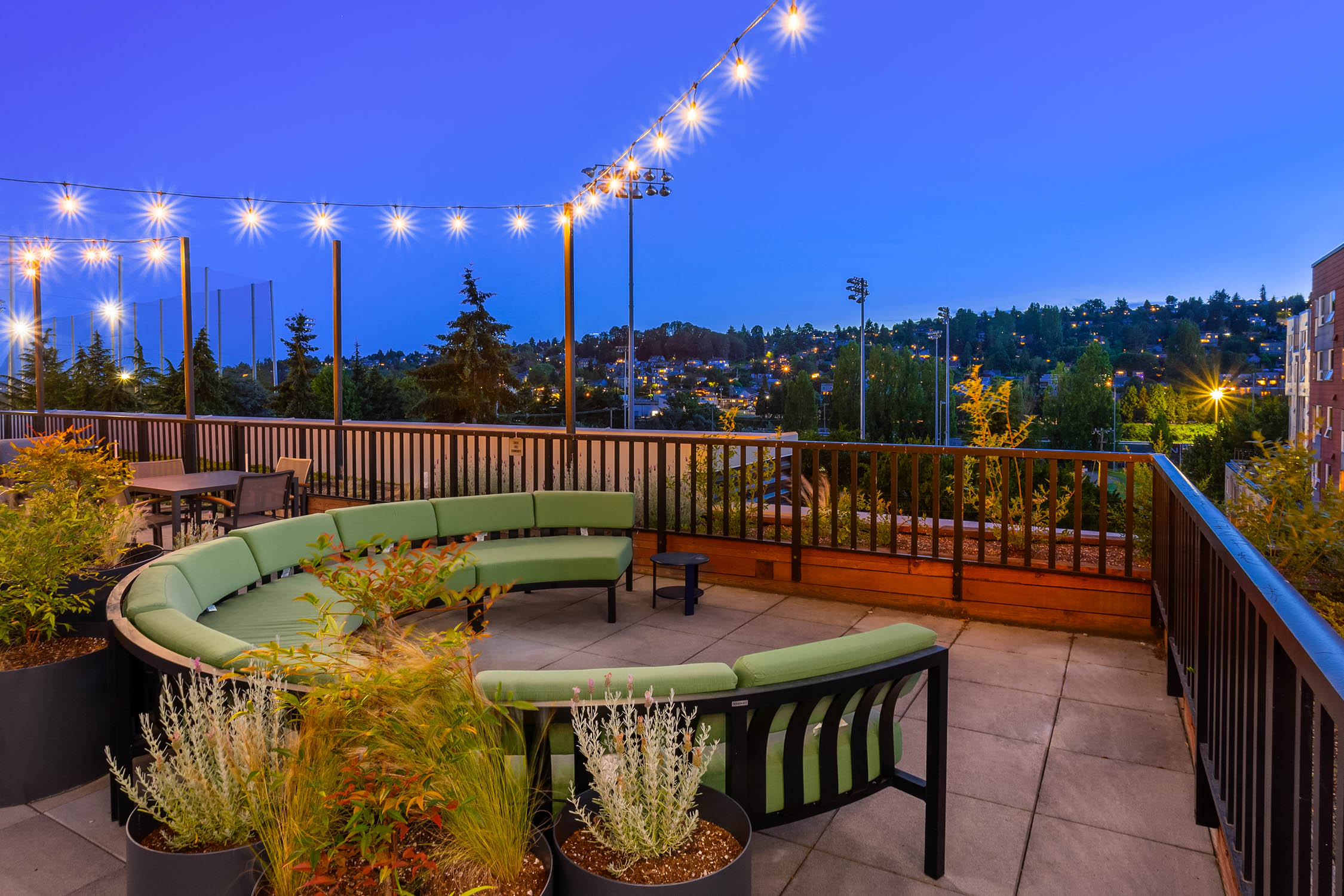
  • Rooftop deck with Olympic Mountains and Puget Sound views, festival lighting, a BBQ and a fire pit.
  • 24-hour fitness center with no separate gym membership required, and a 24-hour co-working lounge.
  • Smart home systems: Wi-Fi thermostats, Alexa-enabled light switches, keyless entry, USB outlets.
  • Built Green 4 Star certified for water and energy efficiency.
  • Controlled access garage and storage, Fetch package receiving, bike storage and repair space.

Studios start at 480 square feet, one-bedrooms reach 809 square feet, and two-bedroom layouts are available. The D Line stops at the door and Expedia’s headquarters is 0.7 miles away. Pets are welcome throughout all 117 homes.

Current offers include up to 8 weeks free rent on select units and up to 6 weeks free on vacant homes, with terms varying by unit and lease length. For how the finishes and design decisions actually read in person, see our look at design-forward apartment interiors in Seattle, or the full amenities list.

Frequently Asked Questions

What defines a luxury apartment?

There is no regulated definition. In practice the term covers high-specification new construction, renovated older buildings and ordinary buildings in expensive neighborhoods. The features worth evaluating are the ones that cannot be retrofitted: window area, ceiling height, sound separation, building systems and full-size in-unit laundry.

What are the luxury neighborhoods in Seattle?

Downtown and Belltown for high-rises, South Lake Union for newer mid-rises near the tech campuses, and Queen Anne for an established residential setting. Interbay has become a value option, with recent construction and current specifications at a lower neighborhood premium than its neighbors.

Are luxury apartments in Seattle worth the premium?

It depends which premium you are paying. Paying for building specification usually shows up in daily life through light, quiet, laundry and working systems. Paying for a neighborhood premium on top of that often does not, which is why the same specification in a well-connected but less fashionable area tends to be the better value.

Do luxury apartments in Seattle allow pets?

Many do, though policies vary considerably and pet friendly rarely means unrestricted. Contour is pet friendly throughout all 117 homes, with pet terms confirmed at the time of application.

What size are the homes at Contour Apartments?

Studios start at 480 square feet and one-bedrooms reach 809 square feet, with two-bedroom layouts also available across the 117-home community.

How far is Contour from downtown Seattle and Expedia’s headquarters?

Expedia’s headquarters is 0.7 miles from the building, walkable or a short bike ride. Downtown is a direct trip on the D Line, which stops at the door. Discovery Park is 1.4 miles away.

What move-in specials are available at Contour?

Current offers include up to 8 weeks free rent on select units and up to 6 weeks free on vacant homes, with terms varying by unit and lease length. Call (206) 650-7565 for what applies to a specific home.

Judge the Building, Not the Brochure

Every building at the top of the Seattle rental market uses the same vocabulary, so the vocabulary has stopped carrying information. What still carries information is the specification: how much glass, how high the ceilings, whether the laundry is full size and in the unit, whether the amenities are open when you are home, and whether the certification is third-party or self-declared.

Contour was built to that standard in a neighborhood that has not yet priced itself accordingly. Come judge it directly: stop by the Open House every Thursday from 3PM to 5PM, browse available apartments, or call the leasing team at (206) 650-7565.

Explore Contour: Availability · Floor Plans · Amenities · Gallery · Neighborhood · Virtual Tours

Schedule a visit

Come see it in person.

Check what is open right now, walk a layout on a virtual tour, or book a time with the leasing team at (206) 650-7565.

View available apartments

Scroll to Top
Contour Apartments at Interbay seal with the building coordinates

Contact Contour at Interbay

Please complete the information below, and we will contact you right away!