🏡 Limited time: Up to 8 Weeks FREE on select homesView Available Units

Open House every Thursday, 3PM – 5PM

Exclusive Offer: 6 Weeks FREE Rent On Select Units! Schedule a Tour Now →


Studio, One Bedroom or Two in Seattle: How to Choose the Right Layout

Studio, One Bedroom or Two in Seattle: How to Choose the Right Layout

TL;DR: The layout decision is usually framed as a budget question and it should be a usage question. The variable that decides it for most Seattle renters is how many hours a week you are actually inside the apartment, which for a city with a high remote work rate is a lot more than it used to be. A studio you work from is a different proposition than a studio you sleep in. At Contour the specification is identical across studios, one-bedrooms and two-bedrooms, so the layout choice is purely about space.

Key takeaways

  • Count the hours you will spend inside the unit before comparing square footage, since that single number decides most of this.
  • A one bedroom buys a door, and the door is worth more than the extra floor area in almost every case.
  • Working from home changes the calculation more than any other factor, and Seattle has an unusually high share of remote workers.
  • Ceiling height and window area affect how large a home feels more than square footage does, so compare units in person.
  • At Contour, quartz counters, luxury vinyl plank flooring and full-size in-unit laundry are identical across studios, one-bedrooms and two-bedrooms.

The Question That Actually Decides It

Most renters approach this as a budget ladder: get the largest layout the budget allows. That produces the wrong answer surprisingly often, in both directions.

The better question is how many waking hours a week you will be inside the apartment. Someone in an office five days a week who goes out most evenings might be in their home for twenty waking hours. Someone working remotely four days a week is closer to seventy. Those two people should not choose the same layout at the same price, and the second one should almost always trade location for space.

Seattle sharpens this because the city has one of the higher remote work rates in the country. A layout decision made on pre-remote assumptions tends to age badly, and the cost of getting it wrong is a year of working from the end of your bed.

Run These Four Numbers

  • Waking hours per week inside the unit. Be honest, including weekends.
  • Days per week you work from home. Even two changes the calculation.
  • How often someone else is in the space. A partner on a different schedule, roommates, guests.
  • What has to be stored. Bikes, skis, camping gear. Seattle households accumulate outdoor equipment.

The right layout is less about square footage and more about how many hours a week you are actually standing in it.

Studios: When They Work

A studio is the most efficient way to buy a location. If the number above is low, that efficiency is real and a studio in a well-connected neighborhood beats a one bedroom somewhere you have to drive from.

Works well when: you are out of the apartment most of the day, you live alone, you do not work from home often, and the neighborhood is doing a lot of the work that a spare room would otherwise do.

Works badly when: you work remotely, because there is no separation between work and rest and the workday never visually ends. Also when you have a cat, which needs somewhere to retreat, or a partner who keeps different hours.

What to check: whether the layout has any natural zoning, meaning an alcove, a partial wall or a kitchen that is not in the middle of the living space. A well-zoned 550 square foot studio lives considerably larger than an open 600 square foot box.

One Bedrooms: Paying for the Door

The price difference between a studio and a one bedroom in the same building is not really buying floor area. It is buying a door, and the door is what does the work.

A door means the workday can end. It means a guest can stay. It means one person can sleep while another is up. It means a cat has somewhere to be when the vacuum comes out. None of that is available in a studio at any square footage.

Works well when: you work from home at all, you share the space, you host, or you simply want the psychological separation between the room you work in and the room you sleep in.

What to check: which direction the bedroom faces and what is outside it. A bedroom on a busy street is a different home from one facing a courtyard, and it is the room where that matters most. Also check whether the bedroom has a real window, since some converted layouts do not.

Two Bedrooms: When the Second Room Pays

A two bedroom is worth it in four situations, and it is overpaying in most others.

  • Roommates. The per-person cost usually drops below what either of you would pay for a one bedroom alone, which is the most reliable argument for it.
  • A genuine home office. If you work remotely most of the week, the second room stops being a luxury and starts being the thing that makes the arrangement sustainable.
  • Two people on different schedules. A second room absorbs the early riser and the night owl.
  • Multiple pets, or a pet plus a guest room. Though note most buildings cap households at two animals regardless of unit size.

What to check: whether the bedrooms are split, meaning on opposite sides of the living space, or adjacent. Split layouts are considerably better for roommates and for sound. Also check whether the second bedroom is a real bedroom or a small interior room, and whether there is a second bathroom, which matters more to roommates than any other feature.

Matching the Layout to the Life
Layout Best for Where it fails Check on tour
Studio Out most of the day, single occupant, buying location Remote work, cats, shared occupancy Natural zoning, alcoves, kitchen position
One bedroom Any remote work, couples, hosting, separation Two people both working from home Bedroom orientation, real window, street noise
Two bedroom Roommates, dedicated office, split schedules Single occupant rarely home, paying for unused space Split or adjacent bedrooms, second bathroom

Why Square Footage Misleads

Two units with identical square footage can feel completely different, and the variables that cause it are not in the listing.

  • Ceiling height. A 9 or 10 foot ceiling makes a compact unit feel generous. Volume is not listed and is worth more than the twenty square feet it is competing against.
  • Window area. Floor-to-ceiling glazing changes the proportion of a room and, in a grey-winter city, changes how it feels for half the year.
  • Layout efficiency. Circulation space, awkward corners and doors that swing into the room all consume floor area that the number counts and you cannot use.
  • Storage. A unit with real closets lives larger than one where storage has to become furniture.
  • Where the kitchen sits. A galley along one wall preserves the living space. A kitchen in the middle of a studio divides it.

This is the argument for touring rather than deciding from a floor plan PDF. The number is a poor proxy for the experience and the gap between them is routinely larger than the gap between two unit types.

The Layouts at Contour

Contour is a 117-home community at 3036 16th Ave W in Interbay, with studios, one-bedrooms and two-bedroom layouts.

Studios start at 480 square feet. One-bedrooms reach 809 square feet. Two-bedroom layouts are also available, and the leasing team can confirm what is open at any given time.

What is worth knowing when comparing layouts here is that the specification does not change between them. Quartz countertops, luxury vinyl plank flooring, stainless appliances, floor-to-ceiling windows and a full-size washer and dryer are consistent across unit types, so the decision is genuinely about space and layout rather than about which tier of finish you are buying.

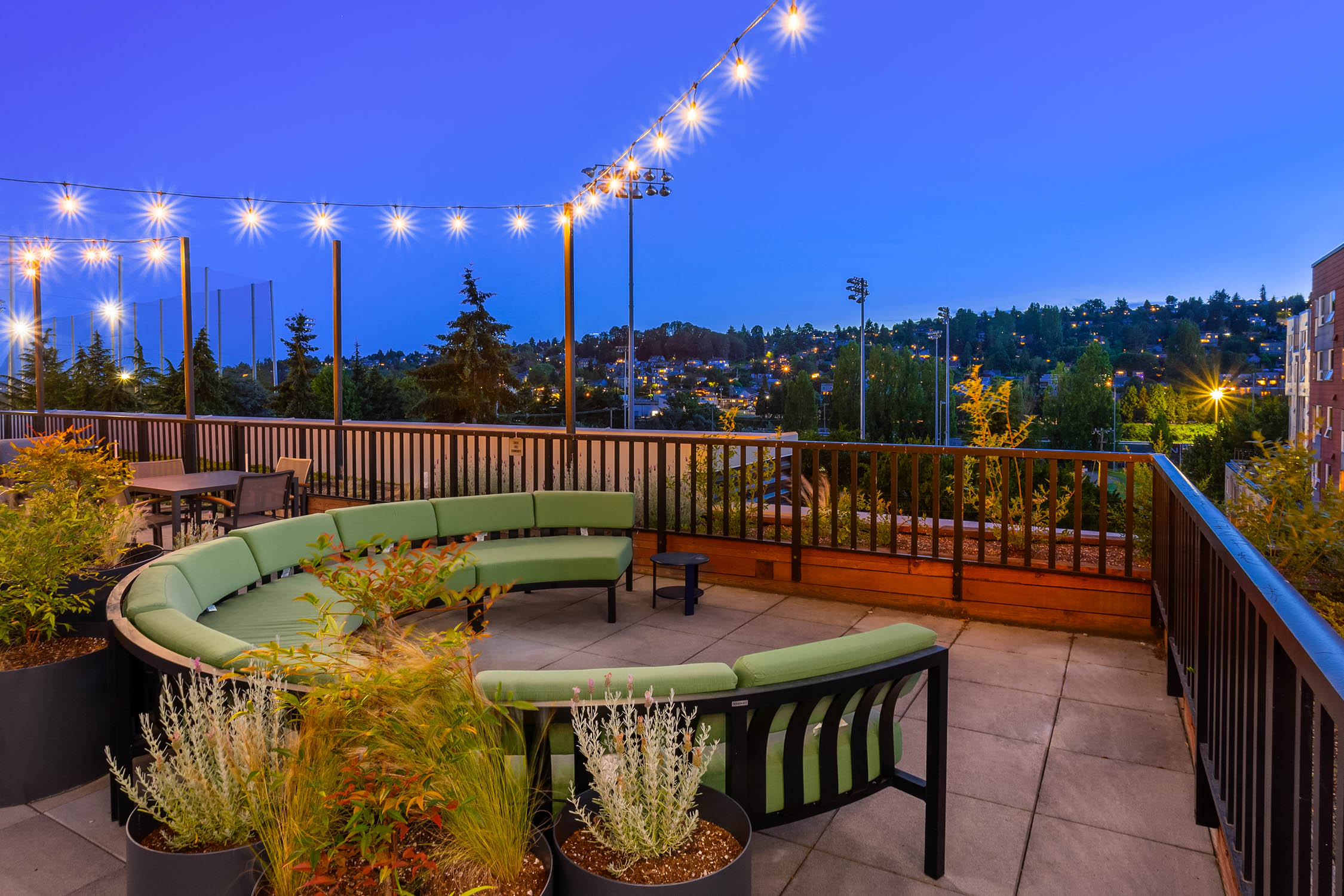
Two building features take pressure off the layout decision specifically. The 24-hour co-working lounge means a studio resident who works remotely has somewhere in the building that is not their apartment, which is the single biggest weakness of a studio. And the rooftop deck, with Olympic Mountains and Puget Sound views, a BBQ and a fire pit, adds outdoor space that no unit type includes on its own.

Current offers include up to 8 weeks free rent on select units and up to 6 weeks free on vacant homes, which sometimes makes a larger layout reachable at a budget set for a smaller one. Browse current available apartments or see the full amenities list. If the trade you are weighing is layout against location, our neighborhood guide covers the other side of it.

Frequently Asked Questions

Is a studio or one bedroom better in Seattle?

It depends on how many hours you spend in the apartment. A studio is the efficient way to afford a better location if you are out most of the day. A one bedroom is close to necessary if you work from home at all, since a studio gives you nowhere for the workday to end.

How big is a studio apartment in Seattle?

Sizes vary by building. At Contour, studios start at 480 square feet. Layout efficiency and ceiling height affect how large a studio feels at least as much as the square footage figure does.

Is it worth paying more for a one bedroom?

Usually, if you work remotely, share the space, or host. What you are buying is a door rather than floor area, and the separation it provides is difficult to replicate in an open layout at any size.

When does a two bedroom make sense for one person?

Mainly when you work from home most of the week and need a dedicated office, or when you have gear and pets that a one bedroom cannot absorb. For someone rarely at home, a two bedroom is usually paying for space that stays empty.

Do bigger apartments have better finishes?

In some buildings yes, which is worth checking. At Contour the specification is consistent across unit types, so quartz countertops, luxury vinyl plank flooring and full-size in-unit laundry appear in a studio as in a two bedroom.

What layouts are available at Contour Apartments?

Studios from 480 square feet, one-bedrooms reaching 809 square feet, and two-bedroom layouts, across a 117-home community in Interbay. Call the leasing team at (206) 650-7565 for current availability by layout.

Choose for the Hours, Not the Budget

The layout question resolves quickly once you stop asking what you can afford and start asking how much time you will spend inside. Low hours, buy the location and take the studio. High hours, especially with remote work in the mix, buy the door and accept a slightly less exciting address. Shared occupancy, get the split two bedroom.

Walking two layouts back to back is the fastest way to settle it. Stop by the Open House every Thursday from 3PM to 5PM, browse available apartments, or call (206) 650-7565 to ask which layouts are open.

Explore Contour: Availability · Floor Plans · Amenities · Gallery · Neighborhood · Virtual Tours

Schedule a visit

Come see it in person.

Check what is open right now, walk a layout on a virtual tour, or book a time with the leasing team at (206) 650-7565.

View available apartments

Scroll to Top
Contour Apartments at Interbay seal with the building coordinates

Contact Contour at Interbay

Please complete the information below, and we will contact you right away!